

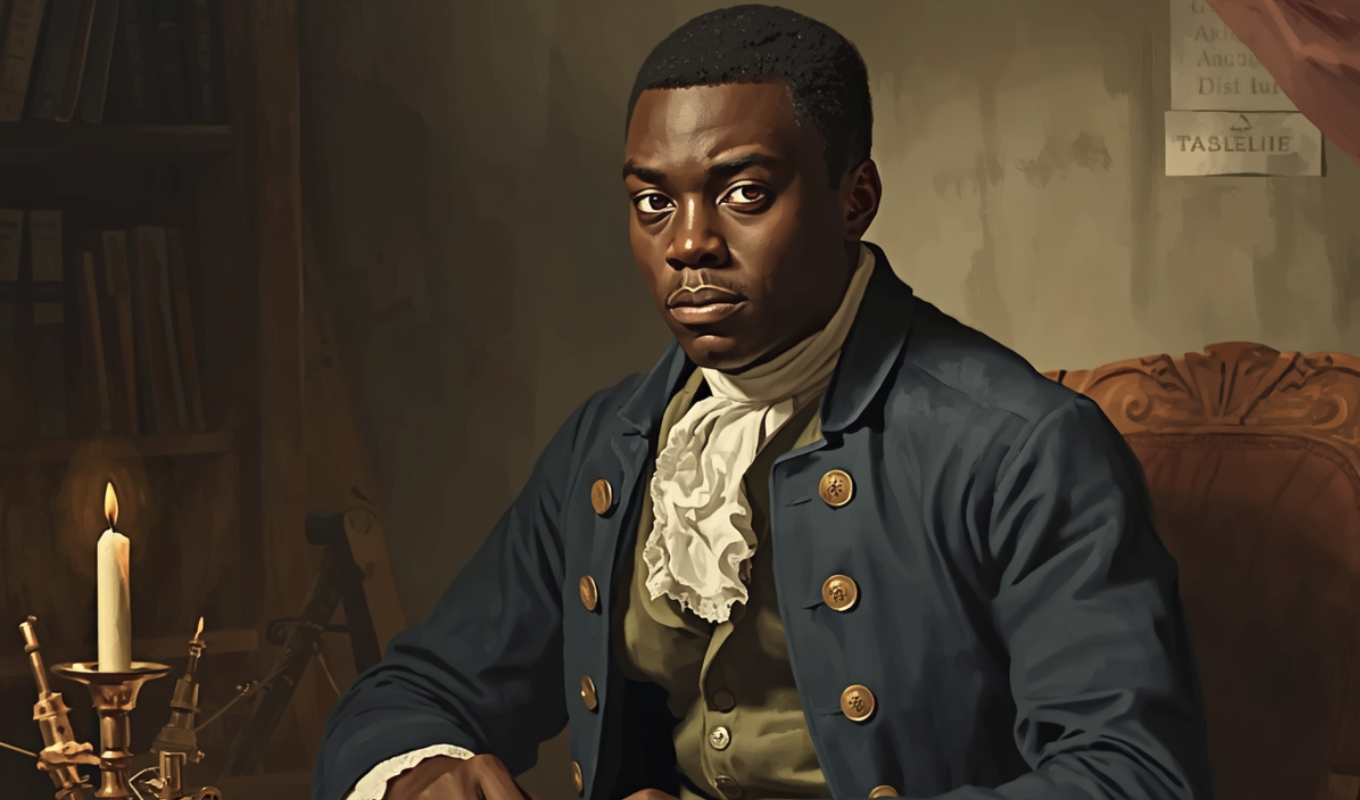
Benjamin Banneker (1731–1806) was a free Black American writer, mathematician, astronomer, and almanac author. Banneker was largely self-educated and became one of the most prominent Black intellectuals of early American history. He operated during the Revolutionary and Founding eras of the United States.
Born on November 9, 1731, Banneker grew up on a 100-acre tobacco farm owned by his parents – a formerly enslaved man and the daughter of a mixed-race couple – along the Patapsco River in the area now known as Oella, in western Baltimore County, Maryland.
Banneker gained national recognition for his almanacs, published between 1792 and 1797. These books contained astronomical calculations, weather predictions, and practical information for farmers. His work demonstrated advanced knowledge of astronomy and mathematics.
He also played a role in surveying land for the future capital of the United States, working with Andrew Ellicott on the layout of what became Washington, D.C..
In addition to his scientific work, Banneker was an outspoken critic of slavery. He famously wrote a letter to Thomas Jefferson, urging him to recognize the intellectual equality of Black people and to end slavery.
Today, Benjamin Banneker is remembered as a pioneering figure in American science and a powerful voice for equality and human rights.
Key Achievements
- The Wooden Clock (c. 1753): In his early twenties, Banneker built a fully functioning striking clock entirely out of wood. He carved each gear by hand, modeling it after a pocket watch he had borrowed. The clock ran accurately for decades.
- Astronomy and Almanacs: Banneker taught himself advanced calculus, spherical trigonometry, and astronomy. He successfully calculated the ephemerides (the predicted positions of celestial bodies) to publish a series of highly accurate commercial almanacs from 1792 through 1797.
- Surveying Washington, D.C. (1791): Banneker was hired by Major Andrew Ellicott to assist in the initial astronomical observations and land surveying required to lay out the borders of the new federal capital, Washington, D.C.