

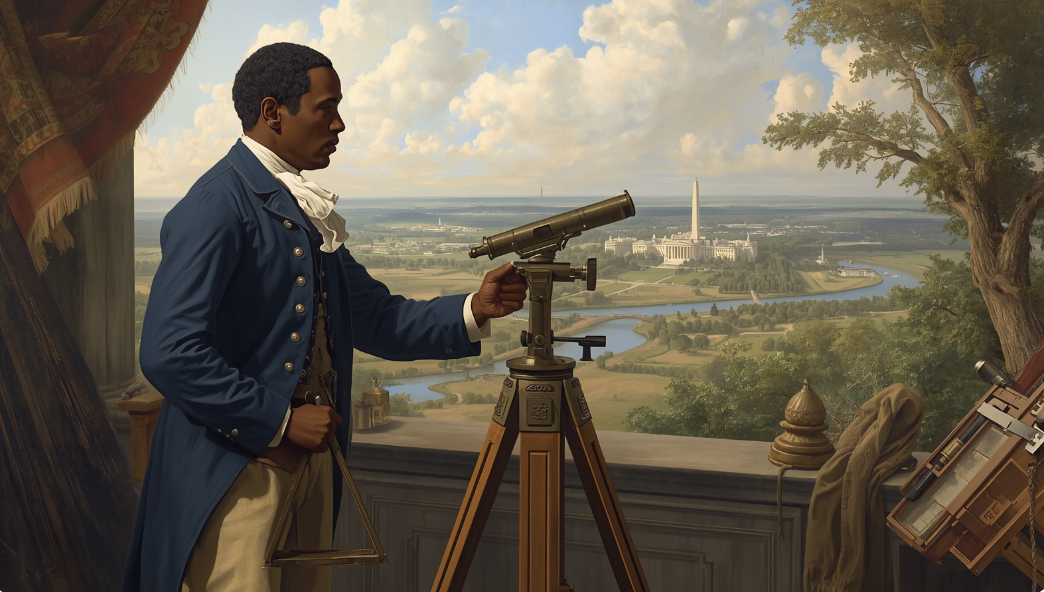
One of the most historically important contributions of Benjamin Banneker was his involvement in surveying the land that became Washington, D.C.. In 1791, Banneker worked with surveyor Andrew Ellicott to help map the boundaries of the new federal capital city.
At the time, the United States was still a young nation, and leaders wanted to create a permanent capital city that would serve as the center of government. Surveying the land was one of the first and most important steps in planning the city.
What is Surveying?
Surveying is the process of measuring land and creating accurate maps. Surveyors determine boundaries, distances, elevations, and directions using mathematics and specialized tools.
In the eighteenth century, surveying was extremely important because maps were needed for:
-
- cities,
- roads,
- farms,
- property boundaries,
- and government planning.
Working with Andrew Ellicott
Benjamin Banneker joined the surveying team led by Andrew Ellicott, one of the most respected surveyors in America at the time. Banneker assisted with astronomical observations and calculations needed to establish the boundaries of the future capital city.
His role involved:
- observing stars,
- tracking planetary positions.
- calculating measurements,
- and helping determine exact locations.
- These calculations were essential because accurate mapping depended on precise positioning and timekeeping.
Banneker’s mathematical skills made him a valuable member of the surveying project.
Astronomy and Surveying
Astronomy played a major role in land surveying during the eighteenth century. Before modern technology such as GPS or satellites, surveyors often used the stars to determine direction and location.
Banneker used his knowledge of:
-
- celestial movements
- eclipse calculations,
- geometry,
- and time measurement to support the surveying process.
His scientific background helped ensure the accuracy of the maps and measurements used for planning Washington, D.C.
Historical Importance of the Project
The surveying of Washington, D.C. was historically significant because it helped establish the permanent capital of the United States. Banneker’s participation in the project demonstrated that African Americans could contribute to important national developments despite widespread racial discrimination.
At a time when many Black Americans were denied educational and professional opportunities, Banneker worked alongside leading scientists and surveyors of his era. His involvement challenged racist assumptions about intelligence and ability.
The project also connected Banneker directly to the early development of the United States government and its national identity.
Myths and Historical Debate
Over time, stories and legends developed about Banneker’s role in designing Washington, D.C. One popular myth claimed that he recreated the city plans from memory after they were supposedly lost.
Historians generally agree that this story is not supported by strong historical evidence. However, there is clear evidence that Banneker contributed to the surveying work and participated in important astronomical calculations during the project.
Even without the myth, his role remains historically meaningful and impressive.
Legacy of His Survey Work
Today, Banneker’s work on the Washington survey is remembered as an important symbol of African American achievement in science and engineering. His participation demonstrated how mathematics and astronomy could be applied to real-world projects that shaped the nation.
His contributions continue to inspire students interested in:
-
- engineering,
- architecture,
- surveying,
- astronomy,
- and mathematics.
Banneker’s role in the survey also highlights the importance of recognizing the contributions of Black scientists and intellectuals in early American history.
Fun Fact
Benjamin Banneker used astronomy to help measure land long before modern GPS technology existe.

This is the heading
Lorem ipsum dolor sit amet, consectetur adipiscing elit. Ut elit tellus, luctus nec ullamcorper mattis, pulvinar dapibus leo.