

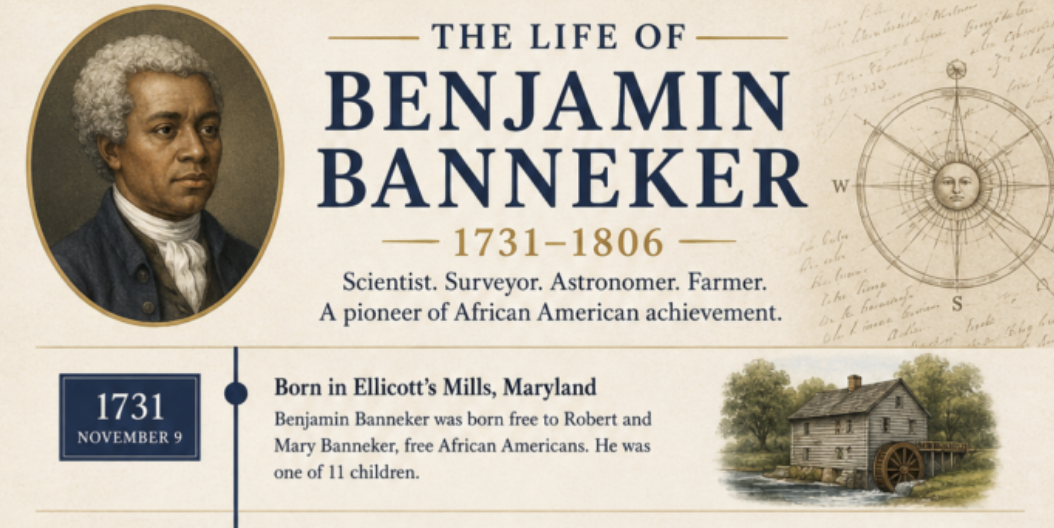
1731 — Birth
Benjamin Banneker was born on November 9, 1731, in Baltimore County, Maryland.
- Born into a free African American family
- Grew up on a tobacco farm
- Lived during colonial America
1730s–1740s — Early Education
Banneker attended a small Quaker school for a short period.
Learned:
- Reading
- Writing
- Arithmetic
After leaving school, he continued learning independently.
Teen Years — Self-Education
As a teenager and young adult, Banneker began teaching himself advanced subjects.
Studied:
- Mathematics
- Mechanics
- Astronomy
- Nature and science
He borrowed books and learned through observation and experimentation.
Early 1750s — Builds the Wooden Clock
Banneker carefully studied a pocket watch and built a large wooden clock by hand.
Importance:
- One of the first striking clocks built in America
- Demonstrated engineering and mathematical skill
- The clock reportedly worked for over 40 years
1760s–1770s — Scientific Study Expands
Banneker became deeply interested in astronomy.
Activities:
- Observed the night sky
- Recorded planetary movements
- Studied eclipse calculations
- Developed advanced mathematical skills
1770s–1780s — Connection with the Ellicott Family
Banneker met members of the Ellicott family, including George Ellicott.
They helped him by:
- Lending scientific books
- Sharing instruments
- Encouraging his astronomy studies
This greatly expanded his scientific knowledge.
1791 — Survey of Washington, D.C.
Banneker worked with Andrew Ellicott helping survey the land for Washington, D.C..
Responsibilities:
- Astronomical observations
- Land measurements
- Mathematical calculations
1791 — Letter to Thomas Jefferson
Banneker wrote a famous letter to Thomas Jefferson criticizing slavery and promoting equality.
Main Ideas:
- All people deserve equal rights
- Slavery contradicted American ideals
- African Americans were intellectually capable
1792–1797 — Publication of Almanacs
Banneker published annual almanacs containing:
- Eclipse predictions
- Astronomy charts
- Weather forecasts
- Calendars
- Farming information
Significance:
- Established his reputation as a scientist
- Challenged racist stereotypes
Late 1790s — Continued Scientific Work
Banneker continued:
- Studying astronomy
- Writing notes
- Observing celestial movements
- Living on his Maryland farm
He remained committed to science throughout his life.
1806 — Death
Benjamin Banneker died on October 9, 1806, at the age of 74.
Shortly after his death, a fire destroyed many of his papers and belongings.
Lasting Legacy
Today, Benjamin Banneker is remembered as:
- A scientist
- Astronomer
- Mathematician
- Inventor
- Writer
- Early advocate for equality
His life continues to inspire students, educators, scientists, and historians around the world.