

Childhood and Family Background
Benjamin Banneker was born on November 9, 1731, in Baltimore County, Maryland, during the colonial period of American history. He was born free at a time when slavery existed throughout the American colonies, making his upbringing very different from the experiences of many African Americans during that era.
Banneker’s family history played an important role in shaping his life. His grandmother, Molly Welsh, was an English immigrant who later purchased and freed an enslaved African man named Bannaky, who eventually became her husband. Their daughter Mary married Robert, a formerly enslaved man from West Africa. Together, they raised Benjamin and taught him the values of hard work, independence, and education.
The Banneker family owned a small tobacco farm in rural Maryland. Life on the farm required discipline and responsibility from a young age. Benjamin helped with farming duties while also developing a strong curiosity about the world around him. Living in the countryside gave him opportunities to observe nature, seasons, weather patterns, and the night sky, experiences that later influenced his interest in astronomy.
Education and Self-Learning
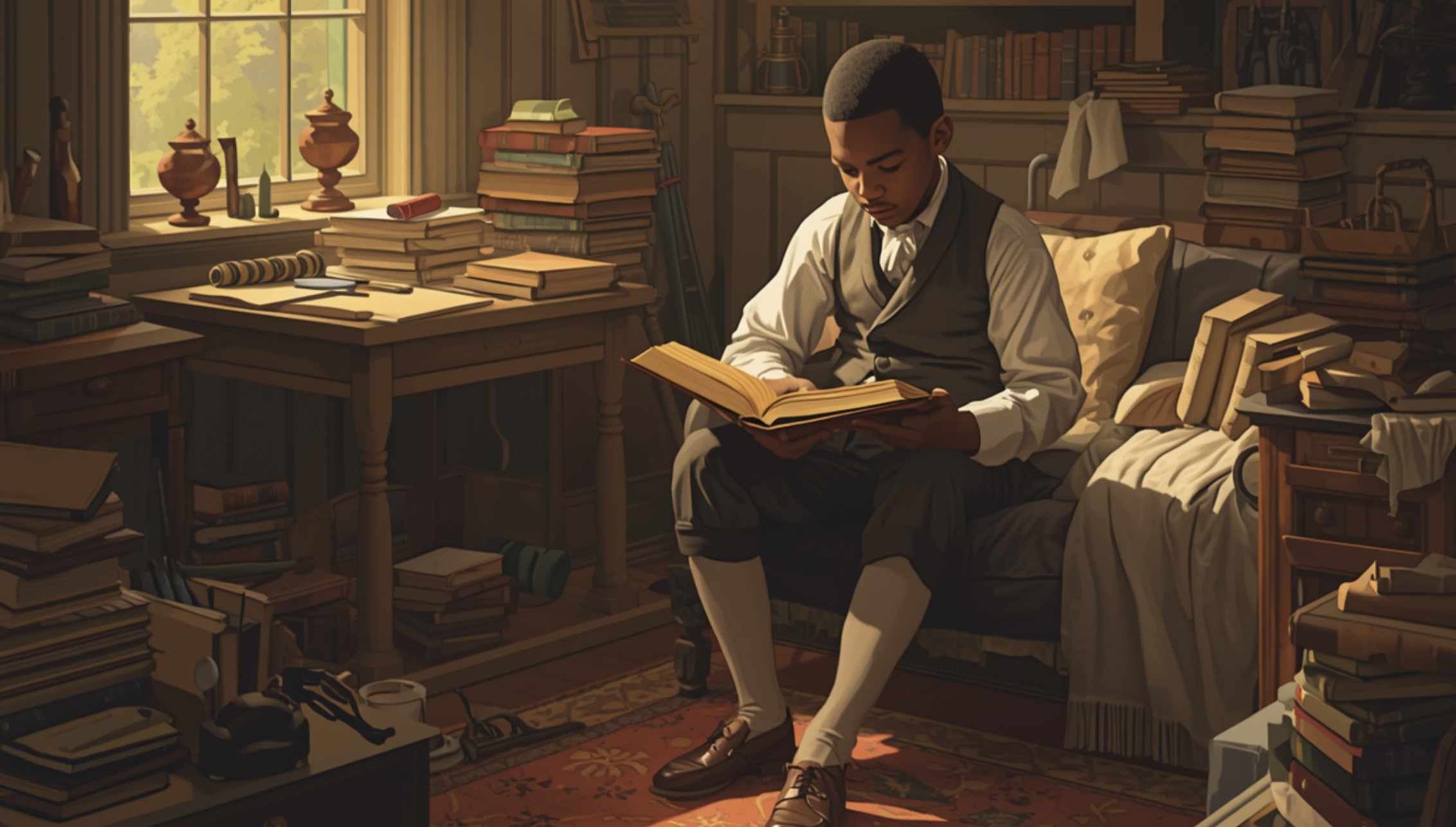
Benjamin Banneker received only a limited formal education. He attended a small Quaker school for a short time during his childhood, where he learned basic reading, writing, and arithmetic. Quakers believed in education for both Black and white children, which was uncommon during that period.
Although his time in school was brief, Banneker had an extraordinary desire to learn. He continued educating himself by borrowing books, reading independently, and studying mathematical problems on his own. Without teachers or advanced schools available to him, he relied on observation, patience, and determination.
Banneker became fascinated by numbers, measurements, and mechanical devices. He carefully studied how objects worked and often experimented with tools and materials around him. His ability to teach himself difficult subjects became one of the defining characteristics of his life.
Interest in Science and Nature
Growing up in rural Maryland allowed Banneker to spend significant time observing the natural world. He watched the movement of stars, phases of the moon, and seasonal changes. These observations sparked his lifelong interest in astronomy and science.
Banneker was known for spending evenings studying the night sky and recording his observations. Over time, he developed advanced mathematical skills that helped him calculate astronomical events such as eclipses.
His curiosity about science was unusual for the time, especially because educational opportunities for African Americans were extremely limited. Despite these obstacles, Banneker proved that intelligence and scientific ability were not determined by race or social status.
Challenges During Colonial America
Benjamin Banneker lived in a society shaped by slavery and racial discrimination. During the eighteenth century, many African Americans were denied educational opportunities and basic rights. Racist beliefs were common, and Black intellectual achievement was often ignored or dismissed.
Despite these social barriers, Banneker gained respect for his knowledge and abilities. His determination to continue learning in the face of discrimination demonstrated remarkable perseverance.
His early life laid the foundation for his future accomplishments in astronomy, mathematics, publishing, and activism. More importantly, it established him as a symbol of self-education, resilience, and intellectual curiosity.